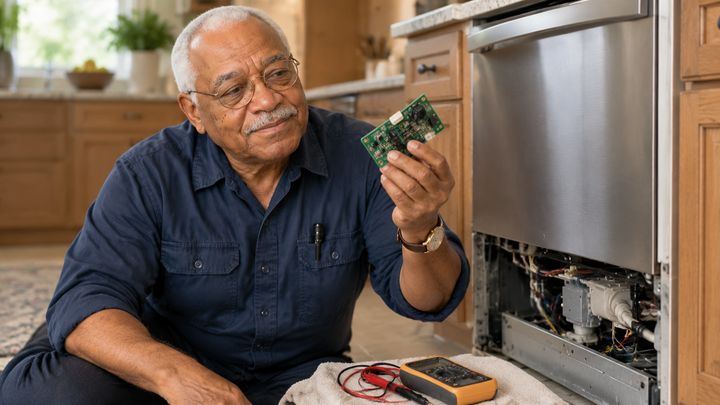
It's rarely a bad machine. It's four moments nobody prepares you for.
I watched good people pay twice for forty years, and almost never because they were careless. Nobody had told them what to check, what to ask, or what they already had for free.
Most of what people pay for twice, they pay for because nobody honest was standing in the kitchen with them. I spent forty years being that person on house calls. This book is that house call, plus a binder of fill-in pages that keeps your whole kitchen on record.
Instant PDF download · 89 pages · 13 printable forms · 30-day money-back guarantee
Watch Clarence explain it in one minute

Paying a technician to press a button. That's what just getting someone through the door typically costs, usually charged even if nothing gets fixed. A tripped outlet, a control lock or a store's demo mode is behind more "dead" appliances than you'd think. Chapter Two is the ten-minute check.
A home warranty you can't use. About $60 a month on average, plus $75–$125 every time a technician comes, and claims get denied for "lack of maintenance." Chapter Five shows what you already have for free.
The skinny water line behind the fridge. 73% of ice-maker losses in one state insurance review came from that supply hose failing, and water damage from appliance lines commonly runs $5,000–$15,000. Chapter One: a braided line and a tagged shutoff.
A compressor quote on a premium fridge. Built-in compressor jobs run roughly $1,100–$1,800 or more, yet some makers cover the sealed system for up to 12 years. Chapter Four: check before you pay for parts.
Real examples and typical ranges from the book's research (published cost guides, insurance data, manufacturer warranty terms), not promises. What you save depends on your home, your machines and your decisions.
Instant PDF · 30-day money-back guarantee
Captions are on. Press play for sound.
If you own a home, here's something nobody tells you about the machines in your kitchen.
Most of what I fixed in forty years wasn't broken. It was dirty, or blocked, or a breaker had tripped. And folks paid me anyway, because nobody had told them what to check. Then there's the quote at the door. The "you might as well buy new." The protection plan at the checkout. That's where good people pay twice.
I'm Clarence. I made house calls for forty years, and I learned one thing: most of that money gets lost because nobody honest was standing in the kitchen with you.
So I wrote The House-Call Book. As you read, you fill in a file for your own home. A month-by-month care calendar. What to say on the phone. The math for repair or replace. And the questions to ask before you buy any warranty.
It comes with a thirty-day money-back guarantee. Start your House-Call File tonight.
Instant PDF · 30-day money-back guarantee
A tired door seal makes the compressor work harder and grows frost where it shouldn't. Here's how I checked one in a customer's kitchen, with nothing but a dollar bill.
I watched good people pay twice for forty years, and almost never because they were careless. Nobody had told them what to check, what to ask, or what they already had for free.

A trip charge to press a reset button, or a padded quote with no breakdown. The checks in Chapter Two and the phone script in Chapter Three end both.

Sometimes that's true. Often it isn't. Chapter Four gives you the ten-minute math, so you decide with numbers instead of nerves.

Stores keep a big share of what you pay for those plans, and the first year often overlaps the warranty you already have. Chapter Five has the nine questions to ask.

Door ice, screens, apps: every feature is a part that can fail. Chapter Six is what a technician looks at before buying, and the checklist for the last kitchen you'll need.
One August afternoon a lady off Peachtree called me about her built-in refrigerator. The freezer was soft and the milk was warm, and the appliance store had already told her a unit that age was probably done. She had a new one picked out.
I took the top grille off, and there was the coil, wearing two years of dust and golden retriever. Fifteen minutes with a brush and a vacuum, and the compressor cycled off for the first time in days. She kept that refrigerator nine more years.
Nobody had ever told her the coil was there. This book is so nobody has to stand alone in their kitchen, guessing, ever again.
Every chapter answers one of them, and your House-Call File keeps the answers.
Dirty coils, clogged filters, a tripped outlet and a forgotten lock cause a big share of "broken" appliances. Chapters One and Two.
Who to call, what to ask on the phone, "what test showed that?", and what common repairs typically cost. Chapter Three.
The repair, the replacement, the warranty plan: the math, the long warranties people forget, and what to buy next. Chapters Four to Six.

"You're the one paying. You get to ask."
As you read, you fill in a record of your own kitchen: what you own, what it needs, every service call, and the words to use when somebody hands you a quote.
How a technician sees your kitchen, the five ways good people pay twice, and the safety rules I never broke.
Coils, gaskets, the dishwasher filter, the dryer vent, washer hoses, the ice-maker line and the self-clean cycle, month by month.
The ten-minute checks, appliance by appliance, cheapest cause first, and the stop signs that mean call now.
Factory-authorized or independent, the phone questions, the door, fair price ranges, and the red flags.
How long things last, my three questions, the one-line rule, and when a premium machine is worth saving.
Store plans, home warranties, your credit card's free extension, and your rights under federal warranty law.
Features that break, reading reliability data, the install-day checklist, and buying for the next twenty years.
Every checklist and price table on a few pages, to tape inside a cabinet door.
Kitchen Inventory, six Appliance Records, The Kitchen Year, Service Call Log, the Phone Script card, Estimate Checklist, Repair-or-Replace Worksheet, Warranty Decoder, Buy-It-Once Sheet, Who to Call.
Big, clear type. Tap any page to see it full size.
Thirteen printable pages, one to a sheet. Print as many copies as you like. Tap any page to enlarge.
Delivered to your email in seconds · one payment · 30-day money-back guarantee
Hype is cheap. Every figure, rule and range in this book traces to a published source, and where the honest answer is "it depends," the book says so and tells you who to ask.
No organization named here is affiliated with or endorses this book.
Print the File, fill in the Kitchen Inventory and the Who to Call page together, and they'll have an honest voice in the drawer for every repair, quote and purchase.
That was my daddy's rule, and I kept it for forty years of house calls in Atlanta: a pressed shirt, shoe covers at every door, and the truth about your machines, even when the truth was cheaper for you than for me. I worked on everything from basic washers to built-in refrigerators that cost more than my first house.
I can't be in your kitchen. So I wrote down everything I'd tell you if I could, and built it around the binder I wish every customer had kept.
— Clarence
Clarence Hollins is a narrator character presented by Lumen Works; his stories are composites drawn from common experiences. The guidance in the book is researched from published sources and is educational, not professional repair, legal or financial advice.

One payment. No subscription, no account to create.
🔒 Secure checkout by Gumroad. We never see your card details.
Launch price, $29 after November 15 · Instant PDF · 30-day money-back guarantee